
Andrew Hecht - Barchart
Mon May 9,
In late January, I wrote that cotton was moving towards the season where the price often peaks. The nearby cotton futures contract was just over the $1.20 level on January 27 after reaching a high of $1.2478.
In that piece, I wrote, " When it comes to cotton in late January 2022, the trend remains higher. While the current cotton bull will eventually end at a price, that level will be a function of sentiment. Do not ignore the sentiment and follow the trend; it is always your best friend. When it bends, the market will tell us when to take profits or shift to a short position in the fluffy fiber.”
As of May 6, the price has not bent all that much as cotton reached a high of over $1.58 per pound last week, the highest price since 2011 when the fluffy fiber traded to an all-time high of $2.27 per pound.
The cotton bull continues to charge higher
Cotton has made higher lows and higher highs since reaching a bottom at 48.35 cents per pound in April 2020.
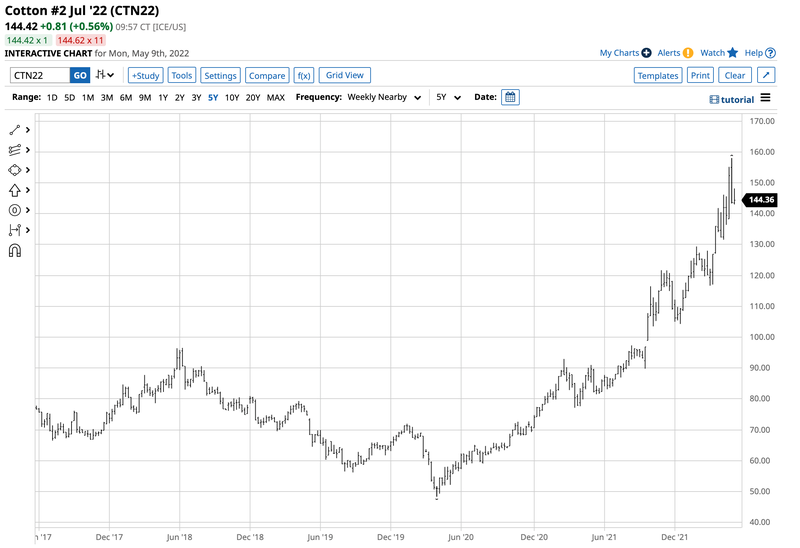
The chart illustrates the climb that took the continuous cotton futures contract to its latest high of $1.5802 per pound on May 4. The cotton futures market corrected from the latest peak. The active month July futures contract was trading below the $1.45 level on May 9.
Cotton ignores rising rates, a strong dollar, and Chinese lockdowns
The bullish trend in cotton has ignored rising US interest rates. Last week, the US Federal Reserve increased the short-term Fund Funds rate by 50 basis points.
The central bank will begin reducing its swollen balance sheet in June, pushing interest rates higher further out along the yield curve. The bond market has moved significantly lower over the past months.
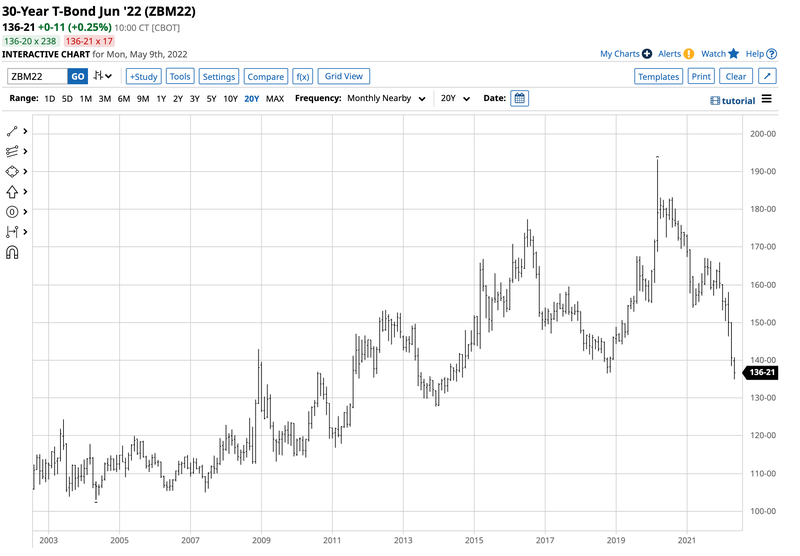
The chart of the 30-Year US Treasury bond futures shows the decline to a low of 136-13 last week, eclipsing the October 2018 136-16 low and level of critical technical support. The long bond fell to the lowest level since July 2014 as interest rates have increased dramatically in 2022.
While the bonds made a multi-year low, the US dollar index rose to a two-decade high.
The dollar index futures contract rose to 104.210 on May 9, moving above the March 2020 103.96 high to the highest level since 2002.
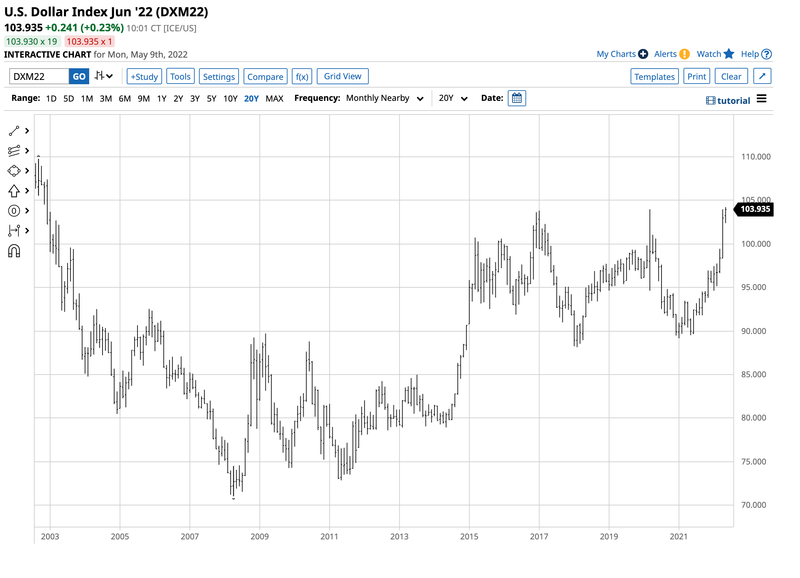
Higher interest rates tend to weigh on commodity prices, increasing the cost of financing inventories. The dollar is the world’s reserve currency and the pricing mechanism for most raw materials. When the dollar rises, it often puts downward pressure on commodity prices because it increases the value in other foreign exchange instruments. Cotton continues to trade in a bullish trend despite the rise in the dollar and higher rates. Moreover, COVID-19 lockdowns in China are causing an economic slowdown in the world’s second-leading economy and the top commodity-consuming country. Cotton has ignored the bearish macroeconomic factors and remains in a bullish trend despite the correction from the most recent high. Drought conditions in Texas are wreaking havoc in the US’s top cotton-growing region, putting upward pressure on cotton’s price.
The elevator ride higher could lead to an elevator shaft correction to the downside
While cotton is trading at its highest price since the 2011 all-time high, the futures market has a history of falling off the side of a bearish cliff when it peaks.
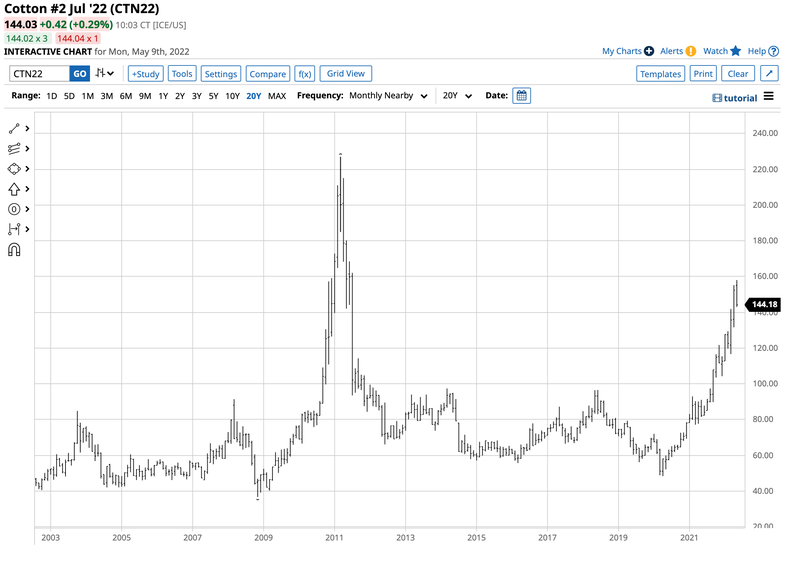
The chart shows in March 2011, cotton moved to a record $2.27 per pound. Four months later, the price was below the $1 level as cotton took an elevator shaft to the downside.
Cotton is a highly volatile soft commodity. The weather, macroeconomic and geopolitical events, and government policies in the world’s leading producing countries, China, India, the US, and Brazil, can impact pricing. Moreover, production is likely to increase at the current high price levels as the cure for high prices in commodities is those high prices.
Meanwhile, rising inflation increases the cost of producing cotton. At over the $1.45 per pound level on May 9, the path of least resistance is uncertain. Technical factors support a continuation of higher lows and higher highs, but the supply and demand fundamentals have bullish and bearish factors pulling the fiber’s price in opposite directions.
The peak season has arrived as cotton often peaks during the spring months
Cotton futures tend to peak during the spring and early summer months. In 2008 and 2011, cotton’s price peaked in March, and in recent years, the annual highs have mostly come from March through July.
Cotton is an agricultural product, with the growing season in China, India, and the US occurring in the spring and summer months. While the weather is always a critical factor for the annual crop, inflation and other factors make 2022 no ordinary year for the cotton market.
Meanwhile, cotton reached its most recent high in early May. Time will tell if cotton’s price continues to climb higher or if the soft commodity reached or is close to the seasonal high.
Risk rises with prices- I have taken profits
The risk of a severe correction in the cotton futures market has increased with the price.
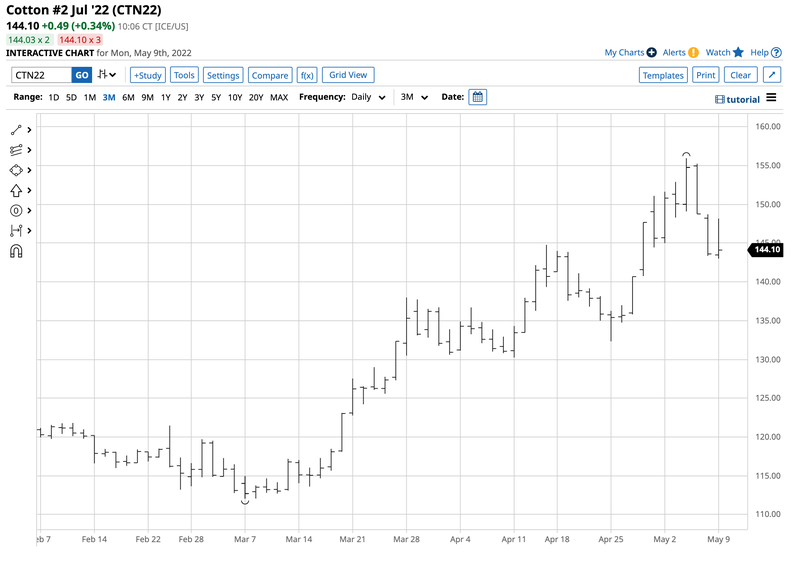
The July futures chart shows technical support levels at $1.3233 per pound, the April 25 low, and $1.3025, the April 11 low. Below there, July cotton traded to a low of $1.1207 on March 7th and 8th, which is a double bottom and critical technical support. I had been long cotton for months via the futures and the iPath Series B Cotton Subindex TR ETN product (BAL). I have taken profits on over 90% of long positions as the price rise, and seasonality dramatically increases the risk of a sharp and sudden downside correction.
It is impossible to pick tops in bull markets as prices can rise to illogical, irrational, and unreasonable levels, as we witnessed in 2011 when cotton exploded to an all-time $2.27 per pound high. At that level, garment manufacturers began replacing cotton with synthetic fibers because of the high cost.
While the technical trend remains high, I am only comfortable with a minimal long position. Adjusting risk-reward horizons involve assessing prices at current levels, not at the original execution prices. While I was very bullish on cotton below $1 and at the $1.20 level, prices above $1.40 and $1.50 are another story. (Source: www.barchart.com)